
Showing posts with label history. Show all posts
Showing posts with label history. Show all posts
Monday, August 25, 2014
In the trenches at Massiges
The highlight, and one of the inspirations for this trip was a visit to the trenches of Massiges. These trenches have been recently been reconstructed to resemble the trenches during World War 1. It is still a work in progress. Signs indicated it was not up to safety standards for public visits...though I doubt it met safety standards in 1914 either.

Côte 304-Hill 304
 |
| Hill 304 was the site of one of the bloodiest and longest lasting battles of WW1.
|
 |
| Like most of these battlefields, the trees were gone during the battles. |
 |
| You can see how the trees have grown back in the trenches. |
 |
| The artillery fire was so fierce that the top of the hill was lowered by 4 meters- a little over 13 feet. |
 |
| The latest battle fought there was between Anne and Jean-Loup-Who found this ladder? |
Varennes-en-Argonne
A short detour to the French Revolution. We stopped where Louis XVI was captured while trying to flee to Austrian controlled Belgium. He had been recognized the night before by a shopkeeper in Sainte-Menehould, who recognized the King's face from the coins. The king should have kept a lower profile.


Fast forwarding back to WW1-Varennes-en-Argonne was later left in ruins after WW1. There is a memorial there built by the State of Pennsylvania honoring those Pennsylvanian volunteers serving during WW1.
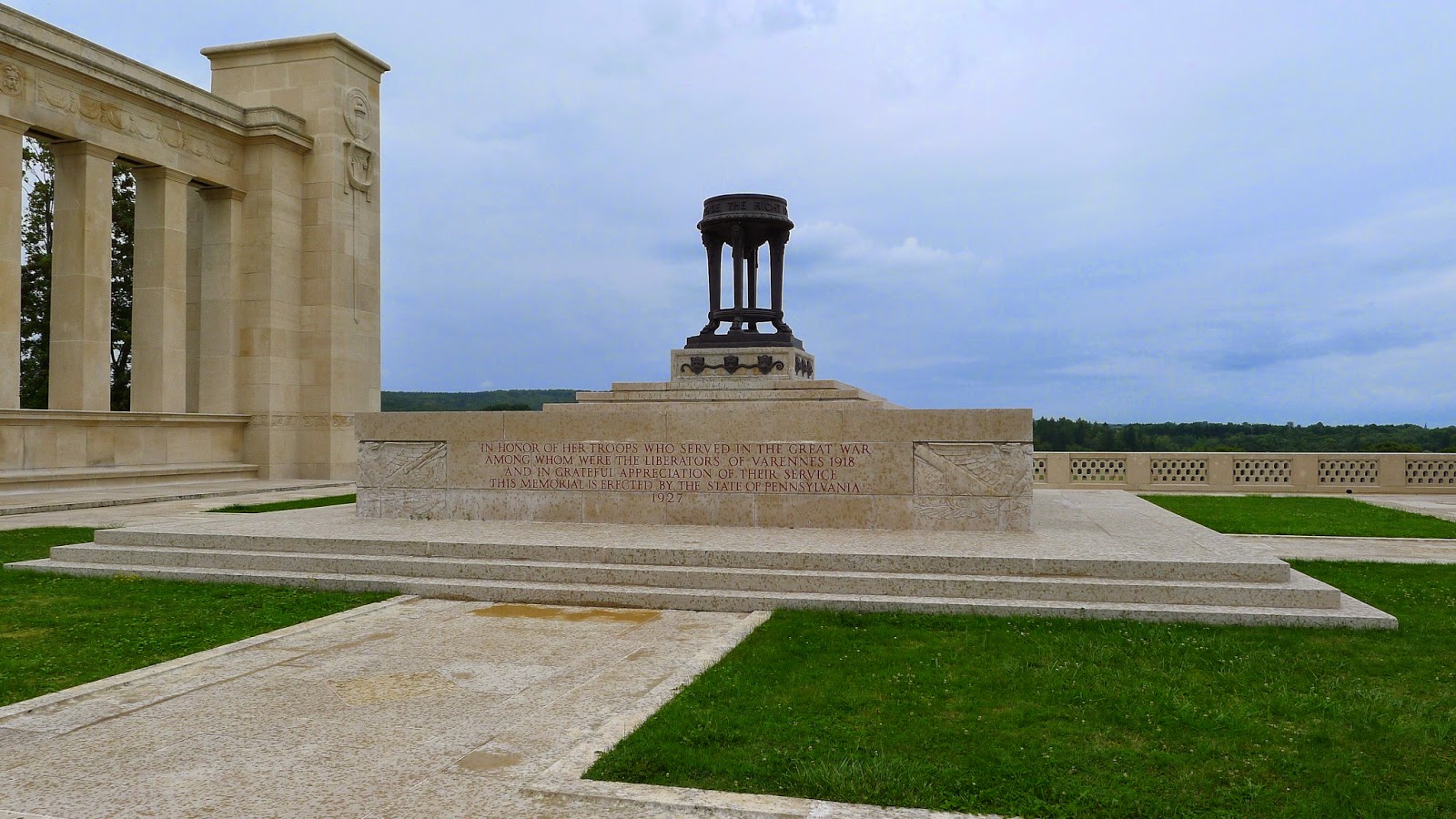

Fast forwarding back to WW1-Varennes-en-Argonne was later left in ruins after WW1. There is a memorial there built by the State of Pennsylvania honoring those Pennsylvanian volunteers serving during WW1.
Abri du Kronprinz
 Prior to and probably during the battle for Verdun in WW1, Kronprinz Wilhelm used these bunkers to help plan their attack.
They lived here and were able to see or easily access the potential battlefields.
 The kids had a lot of fun exploring these hobbit homes.
Thursday, August 21, 2014
Episcopal Palace and the Cathedral of Verdun
 |
| We started our last day in Verdun with a visit to the Bishop's palace. |
 |
| Inside people were just beginning to arrive for work. |
 |
| Today it serves to promote peace in the world. |
 |
| This is the second time we've found pieces of the Berlin wall. The others were in Fulton, Missouri. I think this might be a part of the worlds biggest jigsaw puzzle. |
Tuesday, August 19, 2014
Tranchée des Baionnettes and L'ossuaire de Douaumont
Bayonet trenches
 After the battle this site was discovered with only the bayonets and rifles sticking out of the earth. When they excavated the rifles, a body was found beneath the each rifle. What happened here will never be known. An American benefactor Mr. Rand had the monument built over the trench...

...with a small cross marking the location of each of the unknown soldiers found in the trench.
 Inside this building is housed a cinema like no other in the world. Located behind the walls of the cinema are the bones of the unknown combatants of the battle of Verdun in WW1.


I got my workout for the day...
The kids started climbing to the top of this tower instead of looking at the museum exhibits. I had to climb the stairs two at a time to catch them, since they were having a bit too much fun...there were signs saying to respect the silence...they weren't.
...with a small cross marking the location of each of the unknown soldiers found in the trench.
I got my workout for the day...
The kids started climbing to the top of this tower instead of looking at the museum exhibits. I had to climb the stairs two at a time to catch them, since they were having a bit too much fun...there were signs saying to respect the silence...they weren't.
 |
Though mostly crosses, there are also gravestones for the muslims that fought in the war as well.The destroyed Village of Douaumont This small chapelle was built where an entire village used to stand. Duoaumont was completely destroyed along with 12 other villages in the Verdun region. They have placed markers all along the roads to indicate where each building had been located. |
Monday, August 18, 2014
Fort Vaux and Douaumont
Our first stop after lunch was Fort Vaux. Fort Vaux was the second fort to fall during WW1. Walking through the tight underground corridors it is hard to imagine how the soldiers stationed there and fighting must have felt. This is not a place for claustrophobes.
Fort Vaux
Not even 1 km away from Fort Vaux, we moved forward to 1942 to WW2.
We then returned back to WW1. The second fort we visited was Fort Douaumont. This fort, though larger than Fort Vaux, was not heavily defended and fell rather quickly after being attacked.
Both of these visits were quite interesting as you walk around following a guided tour with an i-Pod explaining the different events, locations in the fort.
Fort Vaux
Not even 1 km away from Fort Vaux, we moved forward to 1942 to WW2.
 |
| WW2 mass grave of resistance fighters |
 |
| They were executed by the Gestapo a few months after Bain-de-Bretagne had been liberated in 1944. |
We then returned back to WW1. The second fort we visited was Fort Douaumont. This fort, though larger than Fort Vaux, was not heavily defended and fell rather quickly after being attacked.
Both of these visits were quite interesting as you walk around following a guided tour with an i-Pod explaining the different events, locations in the fort.
*click on the yellow links to find a Wikipedia article about the history of the fort.
Fort Douaumont
Friday, August 15, 2014
The Subterrainean Citadel of Verdun
 |
| Entrance to Verdun across the street from the tourist bureau. |
Subscribe to:
Posts (Atom)